Green Office Certification
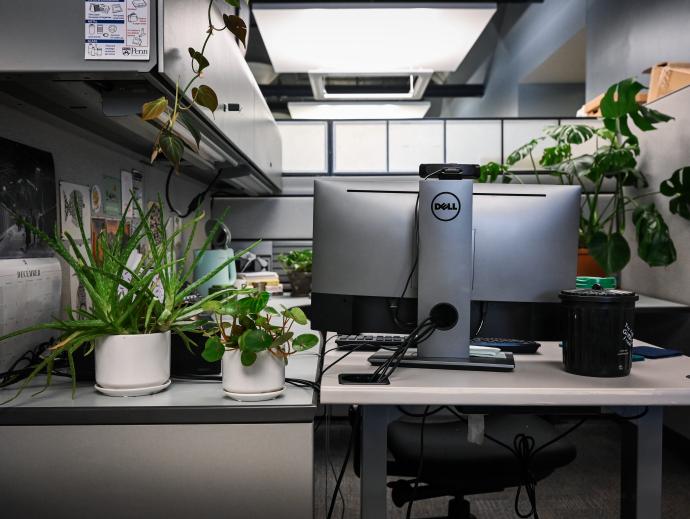
The Green Office Certification recognizes the efforts of staff and faculty to green their daily activities by offering four levels of certification.
Green Office Certification
The Green Office Certification recognizes the efforts of staff and faculty to green their daily activities by offering four levels of certification.
At a Glance
Offices represent a significant portion of Penn’s energy and material use and waste production. The Penn Sustainability Office recognizes the efforts of staff and faculty to green their daily activities by offering four levels of Green Office certification.
Certified offices report on existing activities, and implement new activities, across 7 categories: Waste, Purchasing, Energy, Water, Indoor Air Quality and Human Health, Transportation and Involvement. The more actions you implement, the higher certification level you can achieve.
Since inception of the program, nearly 200 offices across Penn have been Green Office Certified.
How to Get Green Office Certified
- Complete the Green Office Certification Checklist by marking all actions applicable to your office. The checklist with automatically calculate your score.
- Have at least 50% of your office sign the Green Office Certification Application Form. The application also requires a signature from your office head or program director.
- Submit your completed Checklist and Form by emailing them to sustainability@upenn.edu. Please include "green office certification - [Office Name]" in the subject line.
- Staff at Penn Sustainability will review the application. Offices will receive an e-certificate for the level achieved which can be printed and displayed publicly in your office. Your office will also be recognized here as a Certified Green Office.
- Certification is valid for 3 years from the date of the award. To recertify, an office must submit a new application for certification.
The newest version of the Green Office Certification launched on this page in April 2026 (Green Office V4). For those already working toward the earlier version (V3), we will accept submissions for either version until July 31, 2026. The archived V3 checklist and guide are available here. However, we encourage migrating your points and applying through the new V4 checklist.

Green Office Guide
For help completing the checklist, and tips for implementing new actions, you can read the Green Office Guide which includes details for each activity in the checklist, and resources to help you implement them at Penn.
Certification levels
There are 200 possible points that can be earned, and each activity is assigned points according to the impact of difficulty. No office is expected to implement all the actions listed in this document. Points required for certification are:
- Level 1 - 50 points
- Level 2 - 100 points
- Level 3 - 135 points
- Level 4 - 170 points
"We thought it would be best to lead by example, to show what we’re trying to do with our facilities and in our operations, that we’re actually doing it ourselves.”
Current Certified Green Offices
- Perelman School of Medicine - Microbiology Business Office
- Penn Institute for Computational Science
- Procurement Services
- School of Engineering and Applied Science - Planning, Design, and Construction
- School of Nursing - Dean's Office
- School of Nursing - Family and Community Health - Administration
- Division of Business Services
- Division of Business Services - Residential and Housing Services
- Carey Law School - Master in Law
- Penn Dental - Department of Fiscal Operations
- Penn Dental - Department of Oral Medicine
- President's Center - Office of Social Equity and Community
- School of Arts and Sciences - Finance & Administration
- School of Arts and Sciences - Penn Program on Environmental Humanities
- School of Engineering and Applied Science - Chemical and Biomolecular Engineering
- School of Engineering and Applied Science - Computing and Educational Technology Services
- School of Engineering and Applied Science - Dean's Office
- School of Engineering and Applied Science - Electrical and Systems Engineering
- School of Engineering and Applied Science - General Robotics, Automation, Sensing & Perception (GRASP) Lab - Levine Hall
- School of Engineering and Applied Science - General Robotics, Automation, Sensing & Perception (GRASP) Lab - PERCH
- School of Engineering and Applied Science - PRECISE Center
- School of Nursing - Admissions
- School of Nursing - Barbara Bates Center for the Study of the History of Nursing
- School of Nursing - Biobehavioral Health Sciences Department
- School of Nursing - Center for Health Outcomes and Policy Research
- School of Nursing - Eidos LGBTQ+ Health Initiative
- School of Nursing - Global Health Affairs
- School of Nursing - ITS / Ops Suite
- School of Nursing - Laboratory of Innovative and Translational Nursing Research
- School of Nursing - Marketing, Communications and Events
- School of Nursing - Office of Administration and Finance
- School of Nursing - Office of Business and Finance
- School of Nursing - Office of Institutional Advancement
- School of Nursing - Office of Nursing Research
- School of Nursing - Office of School and Community Engagement
- School of Nursing - Office of Global Engagement
- School of Nursing - Simulation Lab
- University of Pennsylvania Museum
- Business Services - Office of Software Licensing
- Dental - Department of Basic & Translational Sciences
- Office of the Executive Vice President
- Office of the University Registrar
- Penn Vet - Office of the Dean
- Perelman School of Medicine - Space Planning & Operations
- University of Pennsylvania Press
- Netter Center for Community Partnerships
- School of Engineering and Applied Sciences - Penn Engineering Online