Earth Week

Earth Week
Built Environment
Civic Engagement
Energy & Climate
Food
Natural Environment
Procurement
Recycling & Waste
Transportation
Wellness
Alumni
Faculty
Staff
Students
Earth Week 2026 logo


Earth Week at Penn is taking place April 18 - 24, 2026. Earth Week presents an opportunity for students, faculty, and staff to engage in cross-disciplinary events designed to educate and foster engagement. This year’s theme is Inspire Informed Action – to spark thoughtful decisions that lead to meaningful environmental change. Earth Week elevates our collective impact by encouraging involvement from all Schools and Centers at Penn. For more information, please contact Noah Swistak, Sustainability Manager, at swistak@upenn.edu.

Interested in hosting an event during Earth Week? Students, faculty and staff across Penn are welcome to do so. Those hosting events are encouraged to use the Earth Week logos and graphic assets in communications materials, and to submit events to the Earth Week calendar.

Earth Week happens every April during the week of Earth Day and presents cross-disciplinary events to educate and inspire action around environmental stewardship, climate, and nature-based solutions.

Submit an Event

Having fun at an Earth Week event

Carbon Offsets

Carbon Offsets

Carbon offsets help Penn address hard-to-eliminate emissions, including those from business-related air travel. Read about how we approach carbon offsets, where they are applied, and how we select projects.

Carbon Offsets

Carbon offsets help Penn address hard-to-eliminate emissions, including those from business-related air travel. Read about how we approach carbon offsets, where they are applied, and how we select projects.

Anchor link: https://www.sustainability.upenn.edu/node/0#offsetsfaq
Link field url: #offsetsfaq

Penn's Approach to Carbon Offsets

Carbon offsets are tradable credits from specific climate mitigation projects or activities, each offset representing one ton of carbon dioxide equivalent. Offsets are issued based on adherence to a protocol specific to the project type, and tracked through a dedicated registry. Credits are used by the purchasing entity to offset the impact of unavoidable or otherwise unmitigated emissions. The voluntary carbon market sets standards and tracks activities for offsets created and purchased by unmandated entities, from individuals to corporations to colleges and universities (Carbon Markets & Offsets Guidance, Second Nature, 2025). 

Penn purchases carbon offsets as a tool to meet its institutional goal of reaching 100% carbon neutral emissions by 2042. The University employs this strategy specifically for emissions it cannot currently eliminate, such as air travel and purchased steam. For Penn, offsets are a supplement to direct emission reductions from measures such as building efficiency upgrades and renewable energy procurement, rather than a primary strategy. Penn considers offset purchases only when other mitigation options are not viable and seeks high quality projects that meet external standards. 

Identifying quality offset projects is challenging and Penn continually strives to improve our understanding of carbon offsets to help ensure our investments result in carbon reductions. Penn’s offset purchasing policy requires that all projects must, at a minimum, adhere to Second Nature’s Carbon Markets and Offset Guidance. Additionally, when reasonable, preference is given to projects that are regional to Penn. Furthermore, Penn seeks to purchase offsets that have a BBB rating or higher from the independent rating agency Calyx Global. Penn uses Calyx Global’s science‑based carbon credit evaluations to ensure that selected projects meet our quality standards. 

For FY24 and FY25 air travel offset purchases, Penn partnered with CNaught, a company that facilitated the purchase of projects that were selected by Penn’s Carbon Offset Working Group and met Penn’s offset guidelines. CNaught provided Penn with a public Impact Dashboard to showcase the scale and type of carbon offsets that the university has purchased.

In July 2020, Penn enacted its Commitment to Travel Sustainability Policy 2371 to foster sustainable travel practices in support of the University’s carbon neutrality commitment. This policy led to the development of the Air Travel Carbon Offset Program – to offset the carbon impact of air travel.  Using Penn’s systems to collect air travel data, a carbon offset investment charge – the Climate Impact Offset or “CLIO” – is applied to University air travel and is used to fund investments in verified initiatives to offset the carbon impact made by those travel estimates. CLIO applies a fee to all University-funded air travel, which is used to purchase carbon offsets for those flight emissions.  Since FY21, the funds collected through the CLIO program had supported projects to offset over 24,000 MTCDE. Read more about Penn’s Travel Sustainability Program on Penn Procurement’s website.  

Many systems on Penn’s campus are supplied by a district energy steam system. Penn’s steam offsets program is a long-running initiative in which the University purchases carbon offsets to compensate for greenhouse gas emissions from the steam it buys to heat and cool campus buildings. This steam is generated off campus and purchased by Penn, so the associated emissions are counted as part of the University’s scope 2 emissions. 

  • Penn has supported landfill gas and methane abatement projects in Virginia, Missouri, and Oklahoma. These projects capture methane that would otherwise escape from landfills or orphaned wells.
  • The first investment from Penn’s Travel Sustainability Fund was in a nitrous oxide (N2O) abatement project at Ascend Performance Materials. The fund helped finance equipment to expand and upgrade the capabilities for destroying N2O. This project aimed to destroy or eliminate a sufficient amount of nitrous oxide produced during the manufacturing of adipic acid.

Climate Impact Offset Charge (CLIO)

Learn how the Climate Impact Offset charge (CLIO) moves us closer towards our carbon neutrality goal.

CNaught Public Impact Dashboard

Clone of Carbon Offsets

Anchor link: https://www.sustainability.upenn.edu/node/0#faq
Link field url: #faq

Penn's Approach to Carbon Offsets

Carbon offsets are tradable credits from specific climate mitigation projects or activities, each offset representing one ton of carbon dioxide equivalent. Offsets are issued based on adherence to a protocol specific to the project type, and tracked through a dedicated registry. Credits are used by the purchasing entity to offset the impact of unavoidable or otherwise unmitigated emissions. The voluntary carbon market sets standards and tracks activities for offsets created and purchased by unmandated entities, from individuals to corporations to colleges and universities (Carbon Markets & Offsets Guidance, Second Nature, 2025). 

Penn purchases carbon offsets as a tool to meet its institutional goal of reaching 100% carbon neutral emissions by 2042. The University employs this strategy specifically for emissions it cannot currently eliminate, such as air travel and purchased steam. For Penn, offsets are a supplement to direct emission reductions from measures such as building efficiency upgrades and renewable energy procurement, rather than a primary strategy. Penn considers offset purchases only when other mitigation options are not viable and seeks high quality projects that meet external standards. 

Identifying quality offset projects is challenging and Penn continually strives to improve our understanding of carbon offsets to help ensure our investments result in carbon reductions. Penn’s offset purchasing policy requires that all projects must, at a minimum, adhere to Second Nature’s Carbon Markets and Offset Guidance. Additionally, when reasonable, preference is given to projects that are regional to Penn. Furthermore, Penn seeks to purchase offsets that have a BBB rating or higher from the independent rating agency Calyx Global. Penn uses Calyx Global’s science‑based carbon credit evaluations to ensure that selected projects meet our quality standards. 

For FY24 and FY25 air travel offset purchases, Penn partnered with CNaught, a company that facilitated the purchase of projects that were selected by Penn’s Carbon Offset Working Group and met Penn’s offset guidelines. CNaught provided Penn with a public Impact Dashboard to showcase the scale and type of carbon offsets that the university has purchased.

In July 2020, Penn enacted its Commitment to Travel Sustainability Policy 2371 to foster sustainable travel practices in support of the University’s carbon neutrality commitment. This policy led to the development of the Air Travel Carbon Offset Program – to offset the carbon impact of air travel.  Using Penn’s systems to collect air travel data, a carbon offset investment charge – the Climate Impact Offset or “CLIO” – is applied to University air travel and is used to fund investments in verified initiatives to offset the carbon impact made by those travel estimates. CLIO applies a fee to all University-funded air travel, which is used to purchase carbon offsets for those flight emissions.  Since FY21, the funds collected through the CLIO program had supported projects to offset over 24,000 MTCDE. Read more about Penn’s Travel Sustainability Program on Penn Procurement’s website.  

Many systems on Penn’s campus are supplied by a district energy steam system. Penn’s steam offsets program is a long-running initiative in which the University purchases carbon offsets to compensate for greenhouse gas emissions from the steam it buys to heat and cool campus buildings. This steam is generated off campus and purchased by Penn, so the associated emissions are counted as part of the University’s scope 2 emissions. 

  • Penn has supported landfill gas and methane abatement projects in Virginia, Missouri, and Oklahoma. These projects capture methane that would otherwise escape from landfills or orphaned wells.
  • The first investment from Penn’s Travel Sustainability Fund was in a nitrous oxide (N2O) abatement project at Ascend Performance Materials. The fund helped finance equipment to expand and upgrade the capabilities for destroying N2O. This project aimed to destroy or eliminate a sufficient amount of nitrous oxide produced during the manufacturing of adipic acid. 

CNaught Public Impact Dashboard


Move-In Green

Move In Green
Civic Engagement
Recycling & Waste
Students


Volunteering

Move-In Green is your chance to help shape a more sustainable Penn – starting the moment new students arrive. As a volunteer, you’ll welcome incoming students and families, share information about Penn’s green initiatives, and provide hands-on recycling support during Move-In. It’s one of the first – and most impactful – ways students can get involved with Penn Sustainability.

You’ll staff info tables at high-traffic locations like Houston Hall, the Quad, and College Houses, help students learn how to recycle properly, and promote opportunities to live and learn sustainably on campus.

This is a unique opportunity to connect with peers, meet staff, build leadership skills, and play a visible role in Penn’s sustainability story.

2026 Dates

  • Monday, August 17: Training + Volunteer Shifts (9:00am - 3:00pm)
  • Tuesday, August 18: Training + Volunteer Shifts (9:00am - 3:00pm)
  • Wednesday, August 19: Volunteer Shifts (10:00am - 3:00pm)

Who Can Volunteer?

Any undergraduate student entering their 2nd, 3rd, or 4th year is welcome and encouraged to apply to volunteer. First-years are encouraged to connect with Move-In Green volunteers during Move-In and get involved in other sustainability initiatives later in the year.

What You’ll Do

  • Attend a 2-hour training session with the Move-In Green team
  • Staff outreach tables during Move-In
  • Educate students about Penn’s recycling system and sustainability programs
  • Provide in-the-moment recycling assistance in College Houses

Why Join?

  • Free early move-in to your College House
  • Free meals (breakfast and lunch on 8/17 and 8/18)
  • A free Penn Sustainability t-shirt
  • Leadership and outreach experience
  • Work with a passionate team of students and staff


Questions?

Contact Noah Swistak, Sustainability Manager, at swistak@upenn.edu.

Move-In Green is a fun, fast-paced volunteer program that helps new and returning students make sustainable choices from day one. As a Move-In Green volunteer, you'll be part of a high-energy team that sets the tone for a greener campus during one of the most significant events of the year – Move-In.

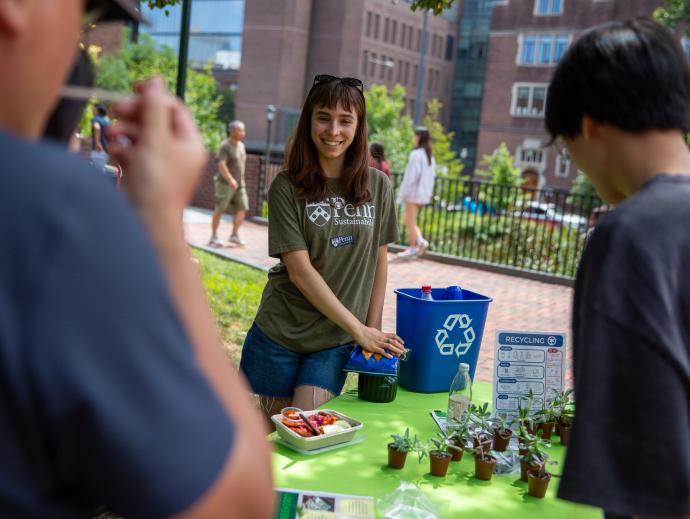
Move-In Green Volunteer talking to new students at table
Purpose

Welcome new students to Penn while promoting sustainable living and responsible recycling.

Activities

Staff info tables, help with recycling, talk to students about sustainability, and support campus-wide green efforts during Move-In.


Anna Balfanz

Anna Balfanz

Anna is the Sustainability Coordinator in the University of Pennsylvania Sustainability Office. The Sustainability Coordinator focuses on outreach programs and works to embed sustainability practices throughout the student experience at Penn. The Coordinator manages programs such as Green Living, Green Office, Civic Sustainability Fellows, and the Penn Employee Alliance for Climate & Environment. The Coordinator also supports the office with communication, including maintaining Penn Sustainability’s website and managing its social media.

Previously, Anna worked at Penn’s Netter Center for Community Partnerships. As an Emerson Fellow, she developed and oversaw environmental justice partnerships between the University and local K-12 schools. In her role as the Academically Based Community Service Research and Program Coordinator, she supported university-community partnerships embedded in courses and research initiatives. She also interned in the U.S. Green Building Council where she developed educational materials on LEED certification for diverse audiences. Anna holds a B.A. in Environmental Studies from the University of Pennsylvania and a Master of Public Administration from the University of Pennsylvania’s Fels School of Government. Anna lives in Philadelphia and loves rock climbing, thrifting, reading, and spending time with her communities.  

Off-Campus Move Out: Donation Drive and Trash Removal

Civic Engagement
Recycling & Waste
Students

Penn students living between 40th and 43rd streets, and Baltimore and Chestnut streets, can schedule a free curbside pickup for their gently used items between May 16th and 31st. Two professional movers and a box truck come directly to your door to haul your donations away—no heavy lifting, no logistics, no stress. 

Furniture is redistributed to support local families throughout Philadelphia. Clothing and electronics are reused or responsibly recycled. Every item given helps keep these items out of landfills while supporting our neighbors in Philadelphia.

The City is also providing additional curbside household and bulk trash pickup days on Mondays, Wednesday, and Fridays between May 9 and 30th. Fridays are bulk trash only. 

The Cleaner, Greener Off-Campus Move-Out program makes donating unwanted items at the end of the year easy with curbside collection for both donations and bulk trash. Facilitated by Penn Sustainability, the Office of Social Equity & Community, Facilities and Real Estate Services, and the Office of Community & Government Affairs, the program reduces neighborhood litter and keeps supplies within the community through an easy donation system.

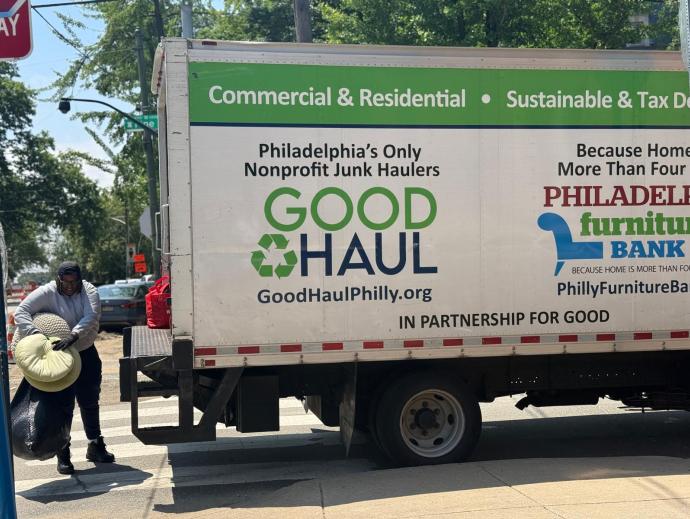
Philadelphia Furniture Bank employees load donations from Penn students into their truck.
Purpose

A Cleaner, Greener Move-Out. Keep useable supplies out of landfills and within the community. 

Alisha Ramirez

Alisha Ramirez

Alisha is the Sustainable Labs Manager in the University of Pennsylvania’s offices of Sustainability and Environmental Health and Radiation Safety. The structure of this role allows Alisha to work at the intersection of laboratory safety and environmental sustainability. She oversees the Green Labs Program at Penn, coordinates events like the annual freezer challenge, and facilitates both the Green Labs Executive Committee and Green Labs Working Group.

Previously, Alisha worked in regulated laboratory spaces. She has worked in biotechnology labs as a lab resources manager and quality assurance associate. Prior to that, Alisha was the supervisor in a wastewater treatment laboratory regulated by the PA DEP and EPA. Alisha holds a B.S. in Environmental Biology from Salem State University and is a candidate in Penn’s Master of Environmental Studies program with a concentration in Environmental Biology. Alisha lives in Philadelphia and volunteers with wildlife surveys at the John Heinz National Wildlife Refuge.

Greenhouse Gas Data Dashboard

Greenhouse Gas Data Dashboard

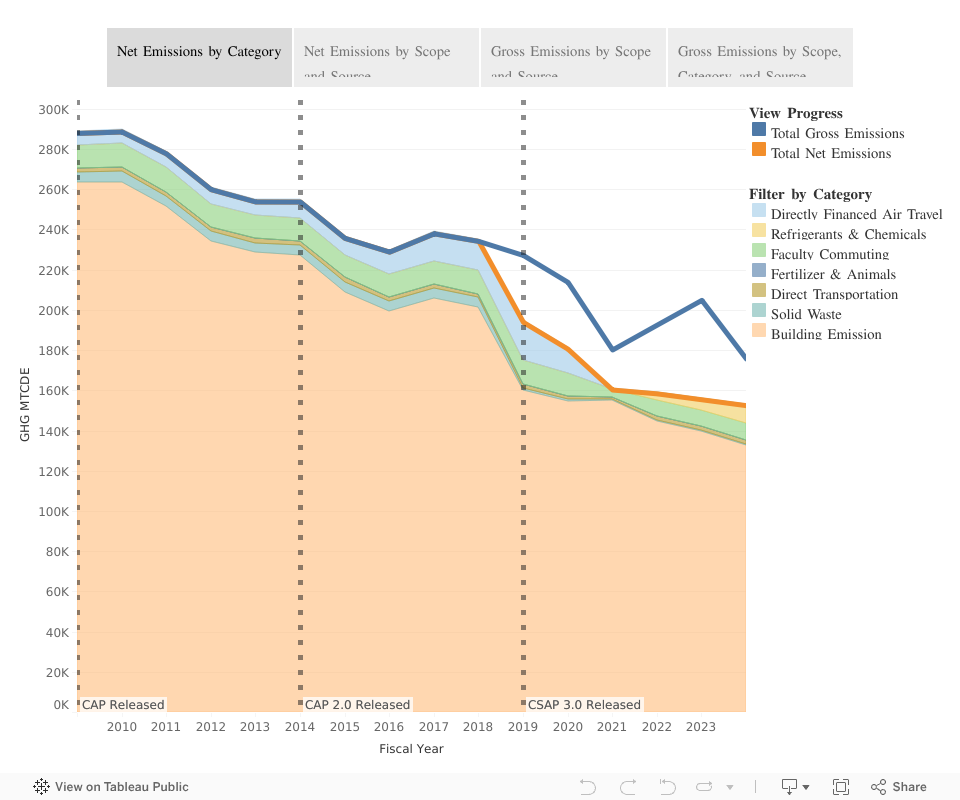
Welcome to our Greenhouse Gas Data Dashboard, a comprehensive tool designed to provide insights into Penn's complex inventory of greenhouse gas emissions. As we navigate the challenges of climate change, understanding and monitoring greenhouse gas emissions is paramount to developing effective mitigation strategies. Our dashboard offers a user-friendly interface, bringing together data from various sources to offer a holistic view of greenhouse gas emissions across different scopes and categories. Whether you're a student, researcher, or concerned citizen, this platform serves as a valuable resource for exploring trends, identifying hotspots, and tracking progress towards a carbon-neutral university. Join us as we delve into the data driving our understanding of climate change and work towards a greener, healthier planet for generations to come.

Our dashboard showcases the annual greenhouse gas emissions of Penn for fiscal years 2009-2024. Penn's fiscal year spans from July 1 to June 30. The dashboard presents both gross emissions, which represent the total greenhouse gas emissions generated by the campus before accounting for any offsets, and net emissions, which reflect the remaining emissions after applying offsets.

You have the option to click on different elements of the graph, adjust the displayed years of data, share the dashboard with others, or download the data.

Please note that the data presented may undergo changes as we continuously strive to enhance data quality and provide a comprehensive overview of our campus footprint.

Greenhouse Gas Inventory (Main Campus)

Scopes

Scopes 1, 2, and 3 emissions categorize different sources of greenhouse gas emissions within an organization's or operational framework. 

  • Scope 1 emissions encompass direct emissions produced by activities under an organization's control, such as those from the combustion of fossil fuels in owned facilities or vehicles. These emissions are typically the most straightforward to measure and manage.
  • Scope 2 emissions involve indirect emissions generated from purchased electricity, heat, or steam used by the organization. While not directly produced by the organization, they are a consequence of its energy consumption and are thus within its sphere of influence.
  • Scope 3 emissions, on the other hand, represent a broader scope, encompassing all other indirect emissions associated with an organization's activities, including those from its supply chain, business travel, waste generation, and product use. These emissions can be more challenging to quantify and control but are crucial for achieving a comprehensive understanding of an organization's carbon footprint and driving sustainability initiatives throughout its entire operation.
Offsets

It is important to note that, currently, the University cannot achieve carbon neutrality without offsets. For FY24, 13% of the carbon footprint was offset. 

  • Steam Offsets: Penn’s steam offsets program is critical in reducing the university’s greenhouse gas emissions by addressing emissions associated with purchased steam. Steam, primarily used for heating and other campus operations, significantly contributes to Scope 2 emissions due to its reliance on fossil fuel combustion, specifically the grid, at external facilities.
  • CLIO Offsets: Air travel comprises 5-10% of Penn’s main campus carbon emissions. Penn faculty, staff, and students who travel on university business are encouraged to choose more sustainable transportation methods when possible, but it is acknowledged that some level of air travel will continue within the Penn Community.  A Climate Impact Offset charge (CLIO) funds the Travel Sustainability Fund to procure offsets for University air travel.
Methodology

While the University internally reports its gross greenhouse gas emissions using both location-based and market-based methods, the visualization above presents emissions using the market-based approach. 

  • Market-based accounting reflects the specific sources of purchased electricity, enabling the use of supplier-specific emission factors. In contrast, location-based accounting relies on average emissions from the regional electricity grid. Using the market-based method is especially important in the case of the University's Solar PPA, as it provides a more accurate representation of emissions directly associated with campus electricity consumption.
Limitations
  • The Greenhouse Gas Inventory presented on this dashboard represents Penn’s main campus operations only and excludes several key properties and entities, including the Hospital of the University of Pennsylvania (HUP), Morris Arboretum, New Bolton Center, and the University's Real Estate Portfolio.
  • Certain emission sources, such as refrigerants and chemicals, were not historically tracked and were only integrated into the carbon footprint starting in 2022. As a result, data for these sources prior to 2022 is unavailable.
  • Additionally, not all Scope 3 emissions are currently measured or reported. Scope 3 emissions encompass a wide range of indirect emissions, many complex and challenging to quantify. While categories such as air travel, and faculty commuting have been included, the University continues to explore methodologies to assess additional Scope 3 categories and incorporate them into the inventory.

Resources

Emissions Category Definitions

  • Refrigerants & Chemicals: Greenhouse gas emissions from the use of refrigerants in cooling systems and other chemicals used in campus operations. These emissions are tracked due to their significant global warming potential.
  • Fertilizer & Animals: Emissions produced from the use of synthetic or organic fertilizers on campus grounds and methane emissions from animals housed on campus for research, education, or other purposes.
  • Direct Transportation: Emissions from vehicles owned and operated by the University, including shuttles, buses, and other fleet vehicles that rely on fossil fuels.
  • Other On-Campus Stationary: Emissions from fuel combustion of natural gas in on-campus equipment and facilities, such as emergency generators, boilers, pottery kilns, and gas fireplaces that are not classified under other categories.

  • Electricity - Chilled Water: Scope 2 emissions from electricity generated off-site and purchased by the University to power chilled water plants that provide cooling to campus buildings.
  • Steam - Chilled Water: Scope 2 emissions from the use of steam produced by external providers, specifically used for steam in chilled water systems to cool campus buildings.
  • Purchased Steam: Scope 2 emissions from the use of steam produced by external providers and used for heating and other operations on campus.
  • Purchased Electricity: Scope 2 emissions from electricity generated off-site and purchased by the University to power campus facilities and infrastructure.

  • Directly Financed Air Travel: Emissions resulting from air travel funded by the University for business or academic purposes. These emissions are part of Scope 3 and include flights taken by faculty, staff, and students for University-related activities.
  • Faculty Commuting: Emissions generated by the transportation of faculty and staff members traveling to and from campus for work. This category falls under Scope 3 and includes various modes of commuting, such as personal vehicles, public transit, and biking.
  • Solid Waste: Emissions resulting from the treatment and disposal of campus-generated waste, including landfilling, incineration, and composting processes.

For additional definitions on all scope 3 emissions, refer to the Greenhouse Gas Protocol's Technical Guidance for Calculating Scope 3 Emissions

FAQs

Yes. In 2009, Penn announced its goal of achieving carbon neutrality by 2042, referred to as the 100% by 42 goal. Through initiatives like energy efficiency, building recommissioning, carbon offsets, and leveraging a cleaner electricity grid, Penn has made significant strides toward this goal. By the end of FY23, Penn had reduced its gross emissions by 46% compared to the FY09 baseline.

No. The Scope 3 emissions associated with the University's endowment are not included in the campus carbon footprint. However, the Office of Investments has committed to achieving net zero greenhouse gas emissions for Penn’s endowment investments by 2050. For more information, visit the University's Climate Investments webpage.

You don’t need to request access, you already have it. As part of Penn’s commitment to transparency, the greenhouse gas inventory and annual updates are published publicly in line with the University’s membership in Second Nature's Climate Leadership Network.

You can download data directly from the dashboard using the icons in the bottom-right corner of the figures. For some datasets, you may need to click on the specific visualization to activate the download option. The same data is also available on SIMAP®.

Not all Scope 3 emissions are currently measured or reported, but many are included. Scope 3 emissions, which encompass a wide range of indirect emissions, are often complex and challenging to quantify. Scope 3 categories such as air travel, faculty commuting, and refrigerants and chemicals are already included in Penn’s footprint. The University is actively working to expand its Scope 3 reporting and incorporate additional categories as methodologies and data collection improve.

Penn is on track to achieve significant greenhouse gas emissions reductions in line with its 100% by 2042 goal. As of FY24, overall emissions have been reduced by 47% compared to the FY09 baseline. However, like other institutions, Penn faces challenges such as supply chain disruptions, labor market constraints in construction, and operational complexities. While these factors may affect the pace of progress, Penn remains committed to pursuing ambitious targets and continuously elevating its sustainability efforts to meet or exceed its goals.

Penn’s path to carbon neutrality involves a multi-faceted approach that includes:

  • Solar Power Purchase Agreement (PPA): Sourcing renewable energy through long-term agreements to reduce dependence on fossil fuels.
  • Building Recommissioning and Renovations: Improving energy efficiency in existing infrastructure through upgrades, retrofits, and recommissioning.
  • Cleaner Electricity Grid: Benefiting from and contributing to regional efforts to transition the energy grid to renewable and low-carbon sources.
  • Offsets: Using high-quality carbon offsets, including for emissions from air travel, to neutralize emissions that cannot currently be eliminated.

While these strategies alone cannot fully achieve carbon neutrality without the aid of offsets, Penn recognizes that innovation, ambition, and future advancements in technology will play a critical role in meeting its long-term goals. The University is committed to staying adaptable and embracing new opportunities for sustainability.